MILD/PILD Coverage and Eligibility: A Patient Guide
What MILD/PILD Actually Refers To
The studies discussed here concern percutaneous image-guided lumbar decompression using the named mild procedure. Their participants had lumbar spinal stenosis with neurogenic claudication associated with ligamentum flavum hypertrophy. This is a defined procedure and study population, not evidence for every operation described as minimally invasive. Confirm the exact procedure name before applying a study to your recommendation.[PubMed][PubMed]
A consultation should establish what problem is being evaluated, which existing records the team needs and which alternatives are relevant. This article does not confirm that a clinician offers a particular procedure or that a reader meets its eligibility requirements.
Why Coverage and Eligibility Are Two Separate Questions
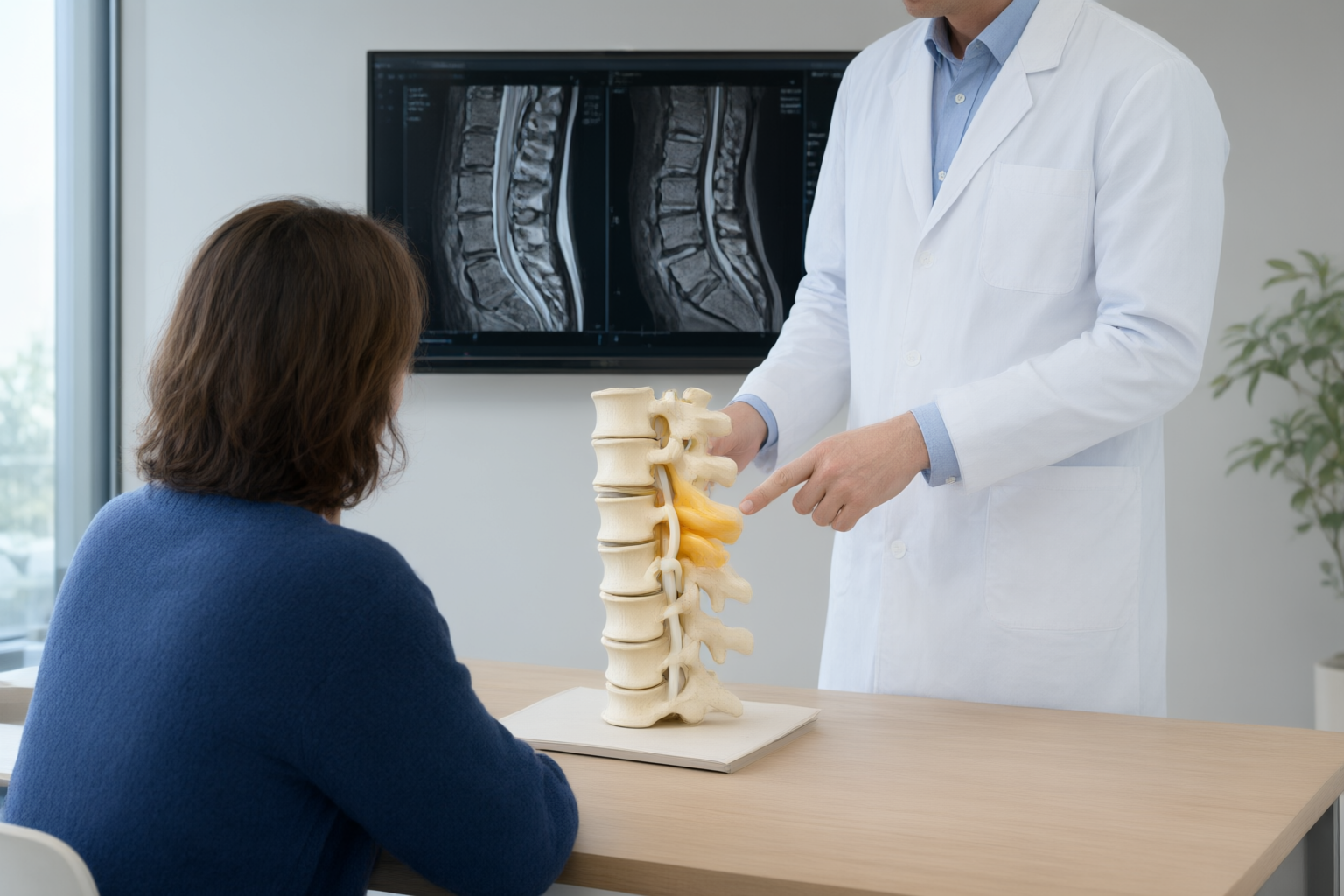
Patients often assume that if a procedure is covered by insurance, they are eligible for it — or that if a surgeon recommends it, insurance will pay. In practice these are two independent gates. Clinical eligibility is decided by a clinician based on diagnosis, imaging, anatomy, prior treatments and personal goals. Payer coverage is decided by the individual plan, its medical policy and any authorization review. Passing one gate does not guarantee passing the other.
MIBSI provides insurance and billing information as part of patient education, but participation, coverage, authorization and any remaining patient responsibility depend on the individual plan and the payer's determination. A general article cannot predict either outcome for a specific person.
Clinical Factors That Typically Shape Candidacy
Ask the clinician how the proposed technique relates to the diagnosis, imaging findings, symptoms and prior care in your records. Ask what additional information is genuinely needed and why. Describing symptoms or bringing an MRI report does not establish that you match a trial population or should have the procedure.
This list is general education, not a checklist you can use to decide your own eligibility. Candidacy is determined through individual evaluation, and this article cannot assess any individual's case.
Bring one recent example of an activity that became difficult and the date or location of existing imaging. The organizer below is for describing your experience and locating records, not a test of eligibility. A blank field does not mean you need another scan.
| Item | Your notes | Question for the team |
|---|---|---|
| Activity example | What you were doing and what made you stop: ____ | Which details help you assess this problem? ____ |
| Existing records | Imaging date, report and image location: ____ | Can you review these existing records? ____ |
| Prior care | What was tried, when, and what you noticed: ____ | Which earlier records would be useful? ____ |
| Technique and next steps | Exact proposed procedure name: ____ | Which study, alternatives and follow-up plan fit this recommendation? ____ |
How Coverage Decisions Are Generally Structured
Between a procedure recommendation and an insurance decision, a fairly predictable administrative sequence usually unfolds: the plan and its medical policy are reviewed, the care team documents the diagnosis and prior conservative care, prior authorization may be requested, and the payer then determines medical necessity. Requirements vary by plan and payer, and this guide cannot predict any individual's coverage outcome. Readers should confirm specifics directly with their plan and care team.
Typical steps from recommendation to coverage decision
- Review the plan's medical policy Ask whether the plan publishes a policy covering the specific procedure and what it requires.
- Document diagnosis and prior care The care team typically records imaging findings and which nonsurgical treatments were tried.
- Submit prior authorization if required Some plans require authorization before the procedure; others do not. Confirm with the plan.
- Receive the payer's determination The payer decides medical necessity under its own policy. Approval is not guaranteed.
How MILD/PILD Compares With Other Decompression Approaches
The named technique and the study comparator matter. MILD/PILD evidence should not be replaced by results for tubular decompression or open laminectomy. In the MiDAS ENCORE randomized study, MILD was compared with epidural steroid injections in patients with lumbar spinal stenosis, neurogenic claudication and verified ligamentum flavum hypertrophy. At one year, the reported disability responder proportions were 58.0% for MILD and 27.1% for injections. Lack of patient blinding and restrictions on additional therapies limit interpretation. This was not a comparison with open laminectomy.[PubMed]
MOTION studied the mild procedure plus conventional medical management against medical management alone. By two years, many control participants had received mild or other interventions, so the authors stated that valid two-year between-group comparisons were no longer possible. Improvement within the treated group is a different question from proving superiority over an intact control group.[PubMed]
The five-year MOTION report followed an extended treatment group, with 34 participants contributing the reported five-year outcomes. Improvements from baseline are useful follow-up information, but this is not a preserved five-year randomized comparison against open surgery or against every alternative treatment.[PubMed]
Ask which study matches the proposed procedure, your diagnosis and the outcome you care about. The table identifies what each report can answer; it does not predict your result or determine coverage.
| Report | Comparison or follow-up | What not to infer |
|---|---|---|
| MiDAS ENCORE, one year | MILD versus epidural steroid injections in the study population | Not a randomized comparison with open laminectomy. |
| MOTION, two years | mild plus conventional management; control crossover limited later comparisons | Do not present two-year within-group improvement as an intact between-group result. |
| MOTION, five years | Extended follow-up of treated participants | Not five years of unchanged randomized control follow-up. |
What Recovery and Logistics Generally Involve
Recovery advice must match the exact procedure, anesthesia plan and your circumstances. A general lumbar decompression surgery guide is not a device-specific MILD recovery schedule. Ask the treating team about transport home, work duties, activity limits, medication questions and who to contact after the procedure.
For background on other decompression operations, see our guide to spinal decompression surgery. Confirm which technique the clinician is actually proposing before applying information from a different operation.
Questions to Bring to Your Consultation and Your Insurer
Preparation is the most practical thing a patient can control. The questions below are designed to surface the information you need — not to guarantee approval or a particular outcome.
| Ask your care team | Ask your insurance plan |
|---|---|
| Which specific technique is being proposed, and why? | Does the plan require prior authorization for this procedure? |
| What documentation will you provide to support the request? | What does the plan's medical policy say about this procedure? |
| Which prior conservative treatments need to be documented? | Which prior treatments must be documented before review? |
| What are the main risks and alternatives for my situation? | What is the appeal or reconsideration process if denied? |
| What follow-up and recovery guidance will I receive? | What costs may remain as patient responsibility? |
Frequently Asked Questions
Does insurance cover MILD/PILD?
Coverage depends on the individual plan, its medical policy and the payer's determination, and prior authorization may be required. This article cannot state whether MILD/PILD is or is not generally covered, and it cannot promise approval. Confirm the specifics with your plan and your care team.
Am I eligible for minimally invasive lumbar decompression?
Eligibility is a clinical determination based on diagnosis, imaging, anatomy, prior treatments and goals, made through individual evaluation. This article deliberately does not list criteria that would let you self-determine eligibility, and it cannot assess an individual case.
Is MILD/PILD safer than open laminectomy?
The direct studies summarized here compare MILD with injections or conventional management; they do not establish that MILD is safer than open laminectomy. Different procedures and populations require their own evidence and an individual discussion.
What is the difference between MILD/PILD and tubular minimally invasive decompression?
These are different procedures, so a study of tubular decompression cannot supply a MILD outcome estimate. Ask the clinician for the exact procedure name, what tissue is being treated and which evidence applies to that procedure.
How long until I can return to work after lumbar decompression?
Ask the treating team about the actual procedure and your work tasks. Do not transfer recovery ranges from general lumbar decompression surgery to MILD as though they were procedure-specific. Confirm activity instructions, transport and follow-up before scheduling.
What if my insurance denies the procedure?
Denial decisions are payer determinations, and plans typically have an appeal or reconsideration process. Ask your plan about the specific policy and appeal steps, and discuss documentation with your care team. A denial is not a guarantee that an appeal will succeed.
Does this article tell me whether I should have this procedure?
No. MIBSI health content is general education and does not replace individualized clinical evaluation or medical advice; treatment selection requires a consultation. The website and general contact form are not monitored for emergencies, and urgent symptoms require emergency services.
References
- MILD® Is an Effective Treatment for Lumbar Spinal Stenosis with Neurogenic Claudication: MiDAS ENCORE Randomized Controlled Trial. — pubmed.ncbi.nlm.nih.gov
- The MOTION study: Two-year results of a real-world randomized controlled trial of the mild® procedure for treatment of lumbar spinal stenosis. — pubmed.ncbi.nlm.nih.gov
- The MOTION randomized controlled trial for treatment of lumbar spinal stenosis using the percutaneous mild® procedure: 5-year results. — pubmed.ncbi.nlm.nih.gov