When to See a Spine Surgeon for Chronic Back or Neck Pain: Signs, Referral Paths, and What to Expect
When Chronic Back or Neck Pain May Warrant a Spine Surgeon Evaluation
There is no single number of weeks that applies to every patient. In general, clinicians consider a spine specialist referral when pain has lasted beyond a usual healing window, when it has not improved despite a reasonable trial of nonsurgical care, or when it comes with nerve-related symptoms such as tingling, numbness, or radiating pain. NHS patient guidance notes that, depending on the underlying condition, nonsurgical care may be tried before surgery such as lumbar decompression is considered. That is a general pattern, not a rule that fits every diagnosis.[nhs.uk]
The practical point is that timing is individual. A clinician decides when a specialist opinion is useful by reviewing your symptom history, a physical and neurological examination, and any imaging you already have. This article is general education only and cannot tell you whether or when you personally should see a spine surgeon.
Symptoms That Need Urgent Care Instead of a Routine Appointment
Some symptoms should not be routed through a routine booking. Sudden severe symptoms, new weakness, loss of bladder or bowel control, numbness in the saddle area, or symptoms that follow significant trauma are situations for emergency services or the nearest emergency department. This is a safety boundary, not a triage tool, and it is not a ranking or diagnosis of causes.
MIBSI's website and general contact form are not monitored for emergencies. If you are experiencing urgent symptoms, contact emergency services rather than waiting for a scheduled appointment.
Nerve-Related Symptoms That Often Prompt a Specialist Referral
Tingling, numbness, or radiating pain in a leg or arm can come from compressed nerves, and NHS patient guidance describes lumbar decompression as lower-spine surgery intended to ease symptoms from compressed nerves, including leg tingling or numbness. Those symptoms are one reason a specialist opinion may be considered useful, because they point to a nerve component that deserves a careful look.[nhs.uk]
Having these symptoms does not by itself mean surgery is needed. The underlying condition, examination findings, and imaging all influence what a clinician recommends, and many people with nerve symptoms are managed without an operation.
What a Spine Surgeon Evaluation Typically Involves
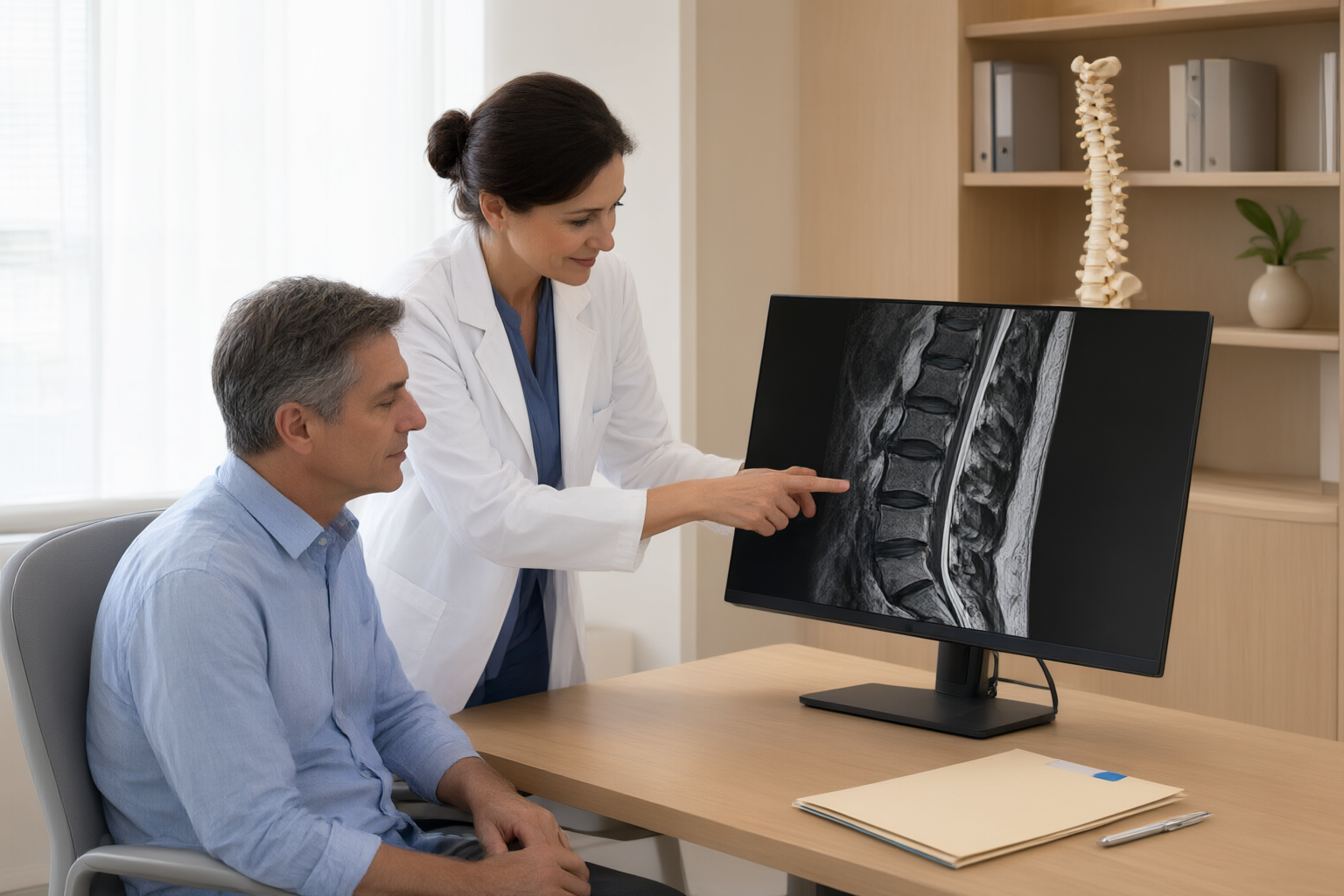
A specialist evaluation generally reviews your symptom history and prior treatments, includes a physical and neurological examination, reviews imaging you already have, and discusses options, including continuing nonsurgical care. If a procedure is being considered, NHS guidance notes that the surgeon explains the planned approach. A consultation is an evaluation, not a commitment to surgery, and it does not guarantee that a specific test, timeline, or operation will be offered.[nhs.uk]
Records and Questions to Bring to a Consultation or Second Opinion
Arriving prepared makes the conversation more useful. Bring imaging discs and reports, a written symptom timeline, the treatments you have already tried and how they went, your current medications, and a short list of questions about diagnosis, options, risks, benefits, and alternatives. This is preparation for shared decision-making, not a checklist that determines whether you are a candidate for anything.
Preparing for a spine surgeon visit
- Gather records Collect imaging discs and written reports, plus any prior specialist notes.
- Write a symptom timeline Note when pain started, what makes it better or worse, and how it affects daily activity.
- List prior treatments Record what you have tried, including physical therapy, medications, or injections, and the result of each.
- Prepare questions Ask about the working diagnosis, nonsurgical options, what surgery would and would not address, risks, and alternatives.
How Surgical Candidacy Is Actually Decided
Duration of pain alone does not decide surgery. Candidacy depends on the diagnosis, imaging and anatomy, the type and severity of symptoms, what nonsurgical treatment has already been tried, and your own goals. The treating clinician makes this judgment individually. NHS guidance also notes that hospital discharge and recovery depend on the operation, the diagnosis, and individual advice, which is another reason no article can determine whether a given patient is a candidate.[nhs.uk]
Comparing Minimally Invasive and Open Decompression: What the Evidence Does and Does Not Show
A 2025 systematic review and meta-analysis compared minimally invasive decompression with open laminectomy for multilevel lumbar spinal stenosis. Across four studies and 618 patients, it reported no statistically significant differences in operation time, complication rate, reoperation for recurrence, one-year low-back pain, or length of stay, while intraoperative blood loss was lower with the minimally invasive approach. Most outcomes had high heterogeneity, and the authors noted inconsistent approaches and decompression techniques across studies.[PubMed]
That finding does not establish that minimally invasive surgery is categorically safer, better, or appropriate for every patient. Technique selection is individualized, and the right questions to ask are about your diagnosis, your anatomy, and the specific approach your surgeon is proposing.[PubMed]
| Outcome | Reported finding |
|---|---|
| Operation time | No statistically significant difference |
| Complication rate | No statistically significant difference |
| Reoperation for recurrence | No statistically significant difference |
| One-year low-back pain | No statistically significant difference |
| Length of stay | No statistically significant difference |
| Intraoperative blood loss | Lower with minimally invasive decompression |
Recovery and Return-to-Work Ranges After Lumbar Decompression
If surgery is chosen, NHS educational guidance describes returning to work at around four to six weeks depending on the job and clinician advice, with usual activities possibly taking up to twelve weeks. These are general ranges, not individual promises. The treating hospital provides wound-care, activity, and follow-up instructions that apply to your situation.[nhs.uk]
Risks and Complications Patients Should Ask About
NHS patient guidance for lumbar decompression names possible complications including cerebrospinal fluid leak, nerve injury, persistent pain, and instability requiring another operation. Ask your own surgeon about the risks specific to your diagnosis and the approach being planned. This article does not provide complication rates or comparisons, because the supplied evidence does not establish them.[nhs.uk]
Next Steps: Scheduling, Second Opinions, and Imaging Review
If you think a spine surgeon evaluation may be appropriate, MIBSI's website supports general pathways such as scheduling, second-opinion requests, imaging review, and general contact. These pathways do not replace a clinical evaluation and are not monitored for emergencies. If you are comparing specialists, our guide to spine surgeon credentials and board certification explains what to verify before you book.
While you wait for an appointment, general conditioning guidance such as spine stabilization exercises can help you understand the role of core strength and back support, though any exercise plan should be discussed with your own clinician.
Frequently Asked Questions
How long does back pain need to last before I see a spine surgeon?
There is no single universal number of weeks. Clinicians commonly consider specialist referral when pain persists beyond a usual healing window or has not improved with a reasonable trial of nonsurgical care, and NHS guidance describes nonsurgical care being tried before lumbar decompression depending on the underlying condition. Individual timing is set by a clinician after reviewing your history, examination, and imaging.
Does seeing a spine surgeon mean I will need surgery?
No. A consultation is an evaluation, not a commitment to surgery, and the options discussed can include continuing nonsurgical care. Whether surgery is appropriate depends on your diagnosis, imaging and anatomy, symptoms, prior treatment, and your goals, and is determined individually by the treating clinician.
Which symptoms mean I should go to the emergency department instead of booking an appointment?
Sudden severe symptoms, new weakness, loss of bladder or bowel control, saddle-area numbness, or symptoms after significant trauma warrant emergency services or the nearest emergency department. MIBSI's website and general contact form are not monitored for emergencies.
Is minimally invasive spine surgery safer than open surgery?
For multilevel lumbar stenosis, a 2025 meta-analysis of four studies with 618 patients found no statistically significant differences in operation time, complication rate, reoperation for recurrence, one-year low-back pain, or length of stay, with lower intraoperative blood loss for minimally invasive decompression. Most outcomes had high heterogeneity. This does not establish categorical superiority or safety, and technique choice is individualized.
What should I bring to a spine surgeon consultation or second opinion?
Bring imaging discs and reports, a written symptom timeline, prior treatments and their results, current medications, and a list of questions about diagnosis, options, risks, benefits, and alternatives. This prepares you for shared decision-making; it is not a checklist that determines candidacy.
How long is recovery after lumbar decompression surgery?
NHS educational guidance describes returning to work at around four to six weeks depending on the job and clinician advice, with usual activities possibly taking up to twelve weeks. These are general ranges, not promises, and the treating hospital provides wound-care, activity, and follow-up instructions.