Minimally Invasive Microdiscectomy in Houston: What the Evidence Says About Candidacy, Relief, and Recovery
What Is a Minimally Invasive Microdiscectomy?
A microdiscectomy is surgery to remove the portion of a herniated lumbar disc that is pressing on a nerve root. In the randomized trial cited in this article, the herniation was located at the L4-L5 or L5-S1 level, and the procedure was performed using conventional microdiscectomy techniques. The goal of the operation is decompression of the affected nerve root, not removal of the entire disc.[PubMed]
The word "minimally invasive" describes the surgical access — a smaller approach to reach the disc — rather than a different surgical objective. The aim of relieving nerve-root pressure is the same; what changes is how the surgeon reaches the area. Patient education material from the American Association of Neurological Surgeons (AANS) notes that herniated disc symptoms vary with the disc's location and which nerve is involved, and that many herniated discs do not require surgery at all.[aans.org]
This article is general education. It does not determine whether any individual is a candidate for surgery, and it cannot replace an evaluation that includes your imaging, neurologic examination, and history.
Who May Be Considered for a Microdiscectomy?
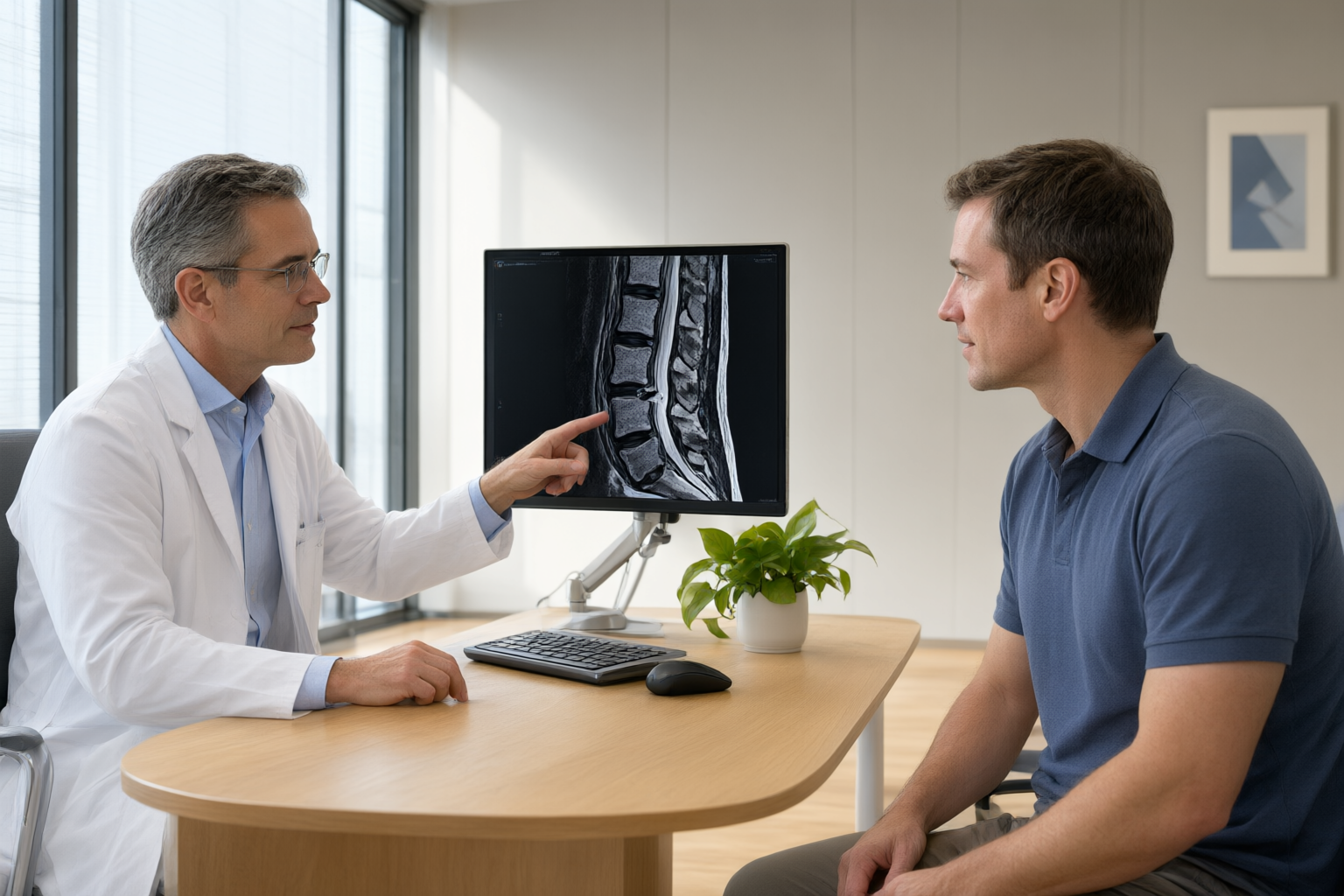
Candidacy is individualized. Clinicians generally weigh several inputs together: imaging that confirms a disc herniation, a nerve-root pattern of leg-predominant pain that matches the imaging, how long symptoms have lasted, how the person responded to prior non-surgical care, and neurologic findings on examination. No single item on that list functions as a decision rule on its own.[aans.org]
The randomized trial cited here gives one concrete example of an enrolled population: adults with sciatica that had lasted 4 to 12 months caused by a lumbar disc herniation at L4-L5 or L5-S1. That describes who was studied, not who should have surgery. AANS patient education emphasizes that many herniated discs do not require an operation, which is why continued non-surgical care is a genuine option for many people rather than a formality before surgery.[PubMed][aans.org]
What the Evidence Shows: Surgery Compared With Non-Surgical Care
The clearest comparative evidence comes from a 2023 systematic review and meta-analysis of randomized trials. It included 24 trials, half of which investigated discectomy compared with non-surgical treatment or epidural steroid injections, involving 1711 participants. Pain scores were converted to a 0-100 scale where higher means worse pain. The certainty of this evidence was graded very low to low, and the benefit declined over time.[PubMed]
A separate single-center randomized trial enrolled 128 patients with sciatica lasting 4 to 12 months from an L4-L5 or L5-S1 herniation. At six months, the leg-pain intensity score was 2.8 in the surgical group and 5.2 in the non-surgical group on a 0-10 scale (adjusted mean difference 2.4; 95% CI 1.4 to 3.4). Of the 64 patients assigned to non-surgical care, 22 (34%) crossed over to surgery at a median of 11 months. This was a single-center trial, so its results reflect one setting and one group of surgeons.[PubMed]
Two caveats matter when reading these numbers. The meta-analysis pooled trials with differing populations, surgical techniques, and follow-up, so heterogeneity limits how precisely any pooled estimate applies to one person. And a mean difference describes groups, not individuals — some patients improve more and some less than the average.[PubMed]
| Source | Comparison | Time point | Result |
|---|---|---|---|
| 2023 systematic review and meta-analysis (24 trials; discectomy comparisons n=1711) | Discectomy vs non-surgical treatment | Immediate term (≤6 weeks) | Mean difference -12.1 (95% CI -23.6 to -0.5) on a 0-100 scale |
| 2023 systematic review and meta-analysis | Discectomy vs non-surgical treatment | Short term (>6 weeks to ≤3 months) | Mean difference -11.7 (95% CI -18.6 to -4.7) |
| 2023 systematic review and meta-analysis | Discectomy vs non-surgical treatment | Medium term (>3 to <12 months) | Mean difference -6.5 (95% CI -11.0 to -2.1) |
| 2023 systematic review and meta-analysis | Discectomy vs non-surgical treatment | Long term (12 months) | Mean difference -2.3 (95% CI -4.5 to -0.2); negligible effect |
| Single-center randomized trial (n=128) | Microdiscectomy vs standardized nonoperative care | 6 months | Leg-pain score 2.8 vs 5.2 on a 0-10 scale (adjusted mean difference 2.4; 95% CI 1.4 to 3.4) |
Risks and Adverse Events: What the Trials Reported
In the 2023 meta-analysis, the risk of any adverse event was similar between discectomy and non-surgical treatment (risk ratio 1.34; 95% CI 0.91 to 1.98). In the single-center randomized trial, nine patients had adverse events associated with surgery, and one patient underwent repeat surgery for recurrent disc herniation.[PubMed][PubMed]
These are trial-level observations, not a personal risk estimate. Individual risk depends on anatomy, overall health status, and the specific procedure under discussion, which is why risks are reviewed case by case with the treating surgeon.[PubMed]
Recurrence and Future Disc Problems: A Discussion for Your Own Case
Recurrent disc herniation is a recognized possibility after discectomy; in the randomized trial described above, one patient required repeat surgery for it. That single event does not establish a general probability, and this article does not estimate an individual's recurrence risk.[PubMed]
What future disc problems may mean for a particular person — including how recurrence likelihood applies to their anatomy and level of herniation — is a topic for the case-specific conversation with the treating surgeon rather than a general statement that applies to everyone.[PubMed]
What Recovery Typically Involves and What It Cannot Promise
Recovery after a microdiscectomy generally involves a period of activity guidance, a gradual return to routine activity, and follow-up with the surgical team. The specifics — including what activity limits apply and when follow-up occurs — are set by the treating clinician based on the individual case.[aans.org]
This article does not provide a guaranteed recovery timeline, a return-to-work date, or a promised outcome. Individual recovery varies, and the trial results described above are group averages rather than a forecast for any one person.[PubMed]
Symptoms That Need Urgent Evaluation, Not a Routine Appointment
Some symptoms should not wait for a scheduled consultation. AANS describes red flags that require immediate medical assessment: urinary retention, loss of bladder or bowel control, altered saddle sensation, and significant weakness. AANS herniated disc patient education likewise notes that significant weakness or new bladder, bowel, or saddle sensory symptoms warrant urgent clinical evaluation.[aans.org][aans.org]
These signs do not by themselves establish a diagnosis or its cause. Seek emergency care for them rather than using this website; general contact forms are not monitored for emergencies.[aans.org]
Questions to Ask Before Agreeing to Surgery
The evidence in this article is most useful when it becomes a set of questions for a consultation. These are discussion prompts, not decision criteria, and the answers depend on your own imaging, examination, and history.[PubMed]
Consultation preparation
- Ask about the imaging Which disc level is involved, and which nerve root do the imaging findings implicate?
- Ask why now Why is surgery being considered at this point rather than continued non-surgical care, given that many herniated discs do not require an operation?
- Ask what the evidence shows What do the randomized trials and the 2023 meta-analysis suggest for a situation like mine, including the very low to low certainty of that evidence and the decline in benefit over time?
- Ask about risks for this case What specific risks apply to my anatomy and health status, and how were adverse events reported in the trials?
- Ask about follow-up What activity guidance, follow-up schedule, and recovery expectations will be provided after surgery?
Where Minimally Invasive Spine Surgery Fits in a Broader Care Plan
A microdiscectomy is one specific decompression procedure for disc herniation. It is distinct from procedures intended for spinal stenosis and from fusion-based stabilization, which address different problems. None of these approaches is superior for all patients; the appropriate option depends on the diagnosis and the individual.[aans.org]
For a wider view of candidacy, procedures, and recovery across minimally invasive spine surgery, see MIBSI's patient guide to minimally invasive spine surgery in Houston. For stenosis-specific coverage and eligibility questions, MIBSI's MILD/PILD coverage article addresses that separate topic.[aans.org]
Frequently Asked Questions
Is a minimally invasive microdiscectomy always better than non-surgical treatment?
No blanket claim is supported. The 2023 meta-analysis found very low to low certainty evidence that discectomy reduced leg pain more than non-surgical treatment or epidural steroid injections in people with a surgical indication, with the advantage largest early and declining by 12 months. The single-center trial found better 6-month leg-pain scores with surgery. Many herniated discs do not require surgery, and the choice is individualized.
How long does the leg pain relief last after a microdiscectomy?
In the 2023 meta-analysis, pooled mean differences on a 0-100 scale were moderate at immediate and short term, small at medium term, and negligible at long term (-2.3; 95% CI -4.5 to -0.2). Those are group averages with very low to low certainty evidence, not a promised duration for any individual.
What are the risks of a microdiscectomy?
The meta-analysis found a similar risk of any adverse event between discectomy and non-surgical treatment (risk ratio 1.34; 95% CI 0.91 to 1.98). In the randomized trial, nine patients had surgery-associated adverse events and one had repeat surgery for recurrent herniation. Individual risk is discussed case by case.
Can the disc herniate again after surgery?
Yes, recurrence is a recognized possibility; one trial patient required repeat surgery for recurrent herniation. Any estimate of future disc problems for a specific person belongs in the treating surgeon's case-specific discussion rather than a general probability presented as fact.
When should I go to the emergency department instead of booking a consultation?
For urinary retention, loss of bladder or bowel control, altered saddle sensation, or significant weakness, seek immediate medical assessment or emergency care. These signs do not by themselves establish a diagnosis, and MIBSI's website and general contact forms are not monitored for emergencies.
Does this article tell me whether I am a candidate for surgery?
No. Candidacy depends on imaging, neurologic findings, symptom duration, response to prior care, and individual goals, and is determined through individual clinical evaluation. This content is general education only.
References
- Surgery versus Conservative Care for Persistent Sciatica Lasting 4 to 12 Months. — pubmed.ncbi.nlm.nih.gov
- Surgical versus non-surgical treatment for sciatica: systematic review and meta-analysis of randomised controlled trials. — pubmed.ncbi.nlm.nih.gov
- AANS Cauda Equina Syndrome — www.aans.org
- AANS Herniated Disc — www.aans.org