Minimally Invasive Spine Surgery: What the Evidence Says About Candidacy, Techniques, and Recovery
What Minimally Invasive Spine Surgery Actually Means
Minimally invasive spine surgery is a way of reaching the spine, not a promise about how you will feel afterward. Instead of a long incision and wide retraction of the back muscles, the surgeon works through smaller incisions using tubular retractors, endoscopes, or similar instruments to reach the same spinal targets that open surgery reaches. The same goals apply: relieving pressure on a nerve, removing a herniated disc fragment, or stabilizing a segment. What changes is the access route and how much muscle and tissue is moved aside along the way.[nhs.uk][orthoinfo.org]
That distinction matters because the phrase itself can sound like a guarantee. It is not. "Minimally invasive" describes technique, and technique alone does not guarantee less pain, a faster return to normal activity, or better results for every patient. Whether a minimally invasive approach is appropriate, and which specific technique is used, depends on your diagnosis, your imaging, the levels involved, and your overall health. Your treating surgeon is the person who explains the planned approach and why it was chosen for your situation.[orthoinfo.org][nhs.uk]
For patients and caregivers comparing spine consultations in Houston, San Antonio or the Dallas–Fort Worth area, use the record-and-question checklist below. Confirm the office address and scheduling route directly with the practice; a general website page does not establish which operations are performed at each location.
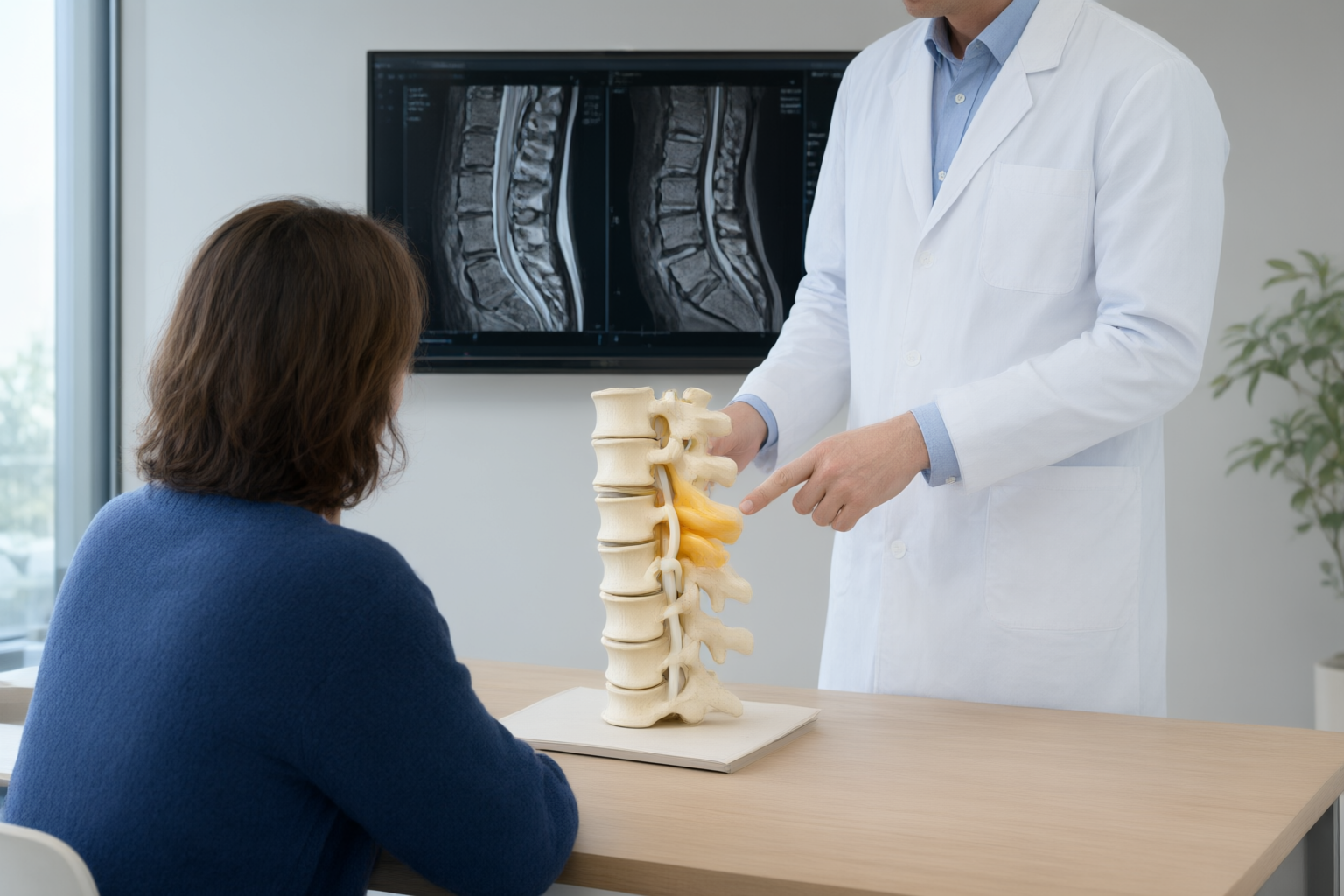
Minimally Invasive vs Open Decompression: What Two Recent Reviews Found
The most honest answer to "is minimally invasive better?" is that the evidence is mixed, and the two most relevant recent reviews do not agree on every point. They also studied different populations, so their findings should be read separately rather than blended into a single verdict.[PubMed][PubMed]
The first review compared tubular minimally invasive decompression with open laminectomy for symptomatic degenerative lumbar stenosis. It pooled nine studies, ten cohorts, and 2,860 patients. The analysis associated the tubular approach with fewer overall complications, fewer surgical-site infections, less blood loss, and shorter hospitalization. It found no statistically significant difference in reoperation, operating time, dural tears, or patient-reported outcomes. Most of the underlying data came from retrospective cohorts, and heterogeneity limits how certain those associations are.[PubMed]
The second review focused specifically on multilevel lumbar spinal stenosis and included four studies with 618 patients. It reported no statistically significant differences in operation time, complication rate, reoperation for recurrence, one-year low-back pain, or length of stay. Intraoperative blood loss was lower with minimally invasive decompression. Most outcomes showed high heterogeneity, and the authors noted inconsistent approaches and decompression techniques across studies.[PubMed]
Read together, these reviews suggest that minimally invasive decompression may offer some advantages in blood loss and, in one analysis, in certain complication and hospitalization measures. They do not establish that it is universally superior, and they say nothing about how quickly any individual patient will recover. Pooled associations describe groups of patients, not your spine.[PubMed][PubMed]
How Candidacy Is Actually Decided
An article cannot establish surgical candidacy. At a consultation, ask which operation is being considered, what it is intended to address, how the evaluation relates to the proposed operation, and which alternatives are relevant. A minimally invasive label is not a substitute for that explanation.
The AAOS page about lumbar artificial disk replacement describes evaluation for that particular operation, including examination, diagnostic testing and consideration of nonsurgical options. Its patient-selection discussion is not a universal checklist for all minimally invasive spine operations. Ask your surgeon which criteria apply to the procedure actually being proposed.[orthoinfo.org]
For decompression procedures, the underlying condition shapes the plan. Depending on the diagnosis, nonsurgical care may be tried first, and the operation itself may involve removing bone, disc material, or both. The surgeon explains the planned approach after reviewing your case. If you are weighing whether to seek another opinion before scheduling, that is a reasonable step and is discussed further below.[nhs.uk]
Procedures Commonly Described as Minimally Invasive
Several spine operations can be performed using minimally invasive techniques. The list below is educational: it is meant to help you recognize terms your surgeon may use, not to suggest that any one procedure is preferred.[nhs.uk][orthoinfo.org]
Tubular or endoscopic decompression removes bone and sometimes disc material to relieve pressure on a compressed nerve. In the lumbar spine, this is the family of procedures most often compared with open laminectomy in the reviews described above. Minimally invasive microdiscectomy targets a herniated disc fragment pressing on a nerve root. Minimally invasive fusion approaches stabilize a spinal segment through smaller incisions, often with instrumentation and bone graft to promote healing. Posterior cervical laminoforaminotomy, which relieves pressure on a nerve root in the neck, can be performed as open surgery or using a minimally invasive method, and it does not always require fusion.[nhs.uk][orthoinfo.org][orthoinfo.org]
For cervical procedures, AAOS guidance describes how the type and location of the problem, patient preferences, surgeon experience, overall health and surgical history can inform the recommended procedure. These are examples in that cervical-surgery context, not a universal eligibility checklist for every minimally invasive spine operation.[orthoinfo.org]
If you want a broader orientation to how a spine practice evaluates patients before choosing among these options, the guide on what patients should understand before choosing care covers that evaluation process.
Risks and Limits Patients Should Hear Directly
Smaller incisions change the approach. They do not eliminate the underlying risks of spine surgery. Patient guidance on spinal fusion and cervical spine surgery lists general risks that include infection, bleeding, nerve injury, spinal cord injury, dural tear with cerebrospinal fluid leak, blood clots, persistent or recurring symptoms, implant-related problems such as misplaced or loosened hardware, and the possibility of needing additional surgery in the future. Some procedures also carry approach-specific risks, such as swallowing difficulty or voice changes after anterior neck surgery.[orthoinfo.org][orthoinfo.org]
Complication rates vary by procedure, diagnosis, and patient factors, which is why your surgeon should discuss your individual risks before surgery rather than offering a single number for all patients. It is also worth knowing what surgery may not solve: some patients experience a return of their original symptoms, and fusion in particular can fail to heal solidly, a situation called pseudarthrosis that may require a second operation.[orthoinfo.org]
Some symptoms should not wait for a routine appointment. New or worsening weakness, or new problems with bladder or bowel control or numbness in the saddle area, warrant urgent clinical evaluation. General patient education on herniated discs makes the same point: significant weakness or new bladder, bowel, or saddle sensory symptoms call for urgent assessment rather than watchful waiting.[aans.org]
Recovery: What Patient Guidance Suggests and What It Cannot Promise
Recovery timelines are best understood as ranges drawn from patient education, not predictions. For lumbar decompression, NHS guidance describes return to work at around four to six weeks depending on the job and clinician advice, with usual activities possibly taking up to twelve weeks. Hospital discharge timing and activity limits depend on the operation performed, the diagnosis, and the instructions you are given individually.[nhs.uk]
Fusion recovery follows a different rhythm because bone has to heal. Patient guidance notes that the fusion process takes time and it may be several months before the bone is solid, although comfort often improves much sooner. Right after surgery, activity may be limited to light walking, with gradual increases as strength returns, and physical therapy typically starts six weeks to three months after surgery.[orthoinfo.org]
After cervical surgery, guidance describes many patients staying in the hospital for one night, though some go home the same day, and notes that it may take six to twelve months for bone to become solid after fusion. Range-of-motion and strengthening exercises often begin gradually around four to six weeks, and return to a desk job may occur within days to weeks, with full activity by three to four months depending on the procedure. These are educational ranges; healing can take longer for some people.[orthoinfo.org]
What no article can do is predict your course. Wound care, activity limits, and follow-up scheduling come from your treating team, and those instructions should take precedence over general ranges you read online.[nhs.uk]
Questions That Change the Conversation at a Consultation
A consultation is more useful when you arrive with specific, answerable questions rather than a general hope for reassurance. The questions below are designed to surface the information that actually shapes a decision, and they work whether you are considering a minimally invasive approach or an open one.[nhs.uk]
One question deserves emphasis: whether a second opinion or imaging review makes sense before you schedule. Because candidacy depends on the diagnosis, imaging findings, and the levels involved, a fresh review of your records can clarify whether the proposed approach matches your situation. If you are comparing surgical options more broadly, the guide to minimally invasive spine surgery in Houston walks through candidacy, procedures, and recovery in more detail.[PubMed]
| Question to ask | Why it matters |
|---|---|
| What is the diagnosed source of my symptoms, and which levels are involved? | Surgery should target an identified structural cause, not symptoms alone. |
| Which approach do you recommend, and what would the open alternative be? | Understanding both options helps you weigh tradeoffs rather than accept a label. |
| How many of these procedures do you perform, and what outcomes do you track? | Experience and outcome tracking are reasonable things to ask about directly. |
| What are my specific risks given my health, prior surgeries, and imaging? | Risk depends on the procedure, the levels, and your individual health factors. |
| What is the plan if symptoms persist or return? | Recurring symptoms and reoperation are recognized possibilities that deserve a plan. |
| Would a second opinion or imaging review be reasonable before scheduling? | An independent review is a legitimate step in shared decision-making. |
Frequently Asked Questions
Is minimally invasive spine surgery safer than open surgery?
There is no blanket answer supported by these reviews. They examine different patient groups and report different patterns of complications. Ask your surgeon which population, operation and comparison in the evidence match the option being discussed; a technique label alone does not establish safety for an individual.
Will I recover faster after minimally invasive surgery?
The evidence is mixed and does not support a guaranteed faster recovery. One review reported shorter hospitalization on average with tubular decompression, while the multilevel stenosis review found no significant difference in length of stay. NHS patient guidance offers educational ranges for lumbar decompression, such as return to work around four to six weeks and usual activities possibly taking up to twelve weeks, but these vary by operation and by individual clinical advice. No article can promise you a specific timeline.
Does a smaller incision mean less risk?
Not automatically. A smaller incision changes the approach, not the underlying risks. General spine surgery risks include infection, bleeding, nerve injury, dural tear, blood clots, persistent or recurring symptoms, implant-related problems, and the possible need for further surgery. Your actual risk depends on the specific procedure, the spinal levels involved, and your health, which is why your surgeon should discuss individual risks with you before surgery.
How do I know if I am a candidate?
Candidacy requires an individual clinical evaluation. Ask which operation is being considered, what it is intended to address, how the evaluation relates to that choice, and which alternatives are relevant. Selection criteria for artificial disk replacement, for example, should not be assumed to govern every minimally invasive spine operation. An article cannot establish your eligibility.
What should I ask before agreeing to spine surgery?
Ask about the diagnosed source of your symptoms and which levels are involved, which approach is recommended and why, and what the open alternative would be. Ask about the surgeon's experience with the procedure and what outcomes are tracked, your specific risks given your health history and imaging, and the plan if symptoms persist or return. Asking whether a second opinion or imaging review is reasonable before scheduling is also appropriate.
When should I seek urgent care instead of waiting for an appointment?
New or worsening weakness, or new bladder, bowel, or saddle-area numbness, warrants urgent clinical evaluation or emergency services rather than a routine appointment. This is a general safety boundary, not a triage tool. This website and any general contact form are not monitored for emergencies.
References
- Minimally invasive decompression versus open laminectomy for multilevel lumbar stenosis: 2025 meta-analysis — pubmed.ncbi.nlm.nih.gov
- Kartal tubular decompression evidence: PMID 41354742 — pubmed.ncbi.nlm.nih.gov
- AANS Herniated Disc — www.aans.org
- NHS lumbar decompression patient guidance, reviewed March 2026 — www.nhs.uk
- Lumbar Artificial Disk Replacement - OrthoInfo - AAOS — www.orthoinfo.org
- Spinal Fusion - OrthoInfo - AAOS — www.orthoinfo.org
- Surgical Treatment for Cervical Radiculopathy - OrthoInfo - AAOS — www.orthoinfo.org